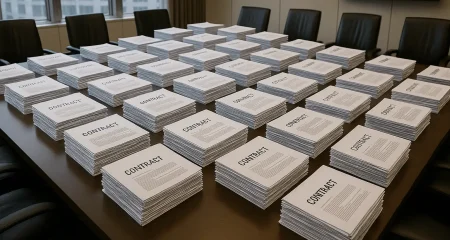
The legal mistakes that most often damage a company’s reputation in the Netherlands are in five areas: employment law, data protection, consumer and advertising law, intellectual property and contract terms. Each can lead to enforcement by a Dutch authority, such as the Dutch Data Protection Authority (Autoriteit Persoonsgegevens, AP) or the Authority for Consumers and Markets (ACM), whose decisions are often published.
The reputational damage usually comes from that publicity, not from the fine itself. Below we explain each mistake, the rule behind it and how to avoid it.
1. How can employment law mistakes hurt your reputation?
Through misclassified workers, unlawful dismissals and poorly handled complaints. Dutch employment law gives employees strong protection, and disputes before the subdistrict court (kantonrechter) are public.
Treating workers as self-employed (zzp’ers) when the relationship meets the definition of an employment contract in Article 7:610 of the Dutch Civil Code (BW) can lead to back payments of wage tax and contributions to the Belastingdienst. From 31 December 2026, a worker paid at most the statutory hourly rate is presumed to be an employee (Article 7:610aa BW).
An employer that wants to dismiss an employee for economic reasons or long-term illness needs permission from the UWV (Article 7:671a BW); for other grounds, the kantonrechter must dissolve the contract (Article 7:671b BW), unless the employee agrees. Discrimination complaints can go to the Netherlands Institute for Human Rights (College voor de Rechten van de Mens), whose opinions are published.
- Give every employee a written contract and apply the applicable collective labour agreement (cao).
- Review freelance relationships before 31 December 2026.
- Have a confidential adviser and a clear complaints procedure for harassment and discrimination.
- Take advice before starting a dismissal.
2. What are the risks under data protection law?
Data breaches and unlawful processing lead to fines and public reports. The GDPR applies directly, and the AP enforces it in the Netherlands, also by publishing its decisions.
Under Article 33 GDPR, a personal data breach must be reported to the AP within 72 hours of discovery, unless it is unlikely to result in a risk to the people concerned. Processing data for purposes you did not disclose, such as marketing without a legal basis, leads to complaints and investigations.
- Publish a clear privacy statement that matches what you actually do with data.
- Process data only for stated purposes, with a valid legal basis.
- Have a procedure to assess and report breaches within 72 hours.
- Conclude processor agreements with suppliers who handle personal data for you.
3. Which consumer and advertising rules are often broken?
Misleading claims, unclear prices and hidden advertising. Under Article 6:193b BW, an unfair commercial practice towards consumers is unlawful, and the ACM can impose fines and publish its decisions.
Prices must include all unavoidable costs, and sponsored content and influencer posts must be recognisable as advertising. Consumers report problems to ConsuWijzer, the ACM’s information desk, which feeds enforcement.
- Make sure every advertising claim can be substantiated.
- Show total prices, including all unavoidable extra costs.
- Label sponsored posts and influencer content as advertising.
- Review your consumer terms regularly against the black and grey lists.
4. What goes wrong with intellectual property?
Using others’ work without a licence, and failing to protect your own brand. Copyright arises automatically when a work is created; there is no registration, so check that you have a licence for every photo, text and piece of music you use.
Collective management organisations such as Buma/Stemra and enforcement foundations such as BREIN act against unlicensed use. Your own trade mark is only protected in the Benelux once it is registered with the Benelux Office for Intellectual Property (BOIP), or in the whole EU with the EU Intellectual Property Office (EUIPO).
- Register your trade marks and designs with BOIP or EUIPO before you launch.
- Keep licences for third-party photos, texts and music.
- Obtain a written transfer of copyright from freelancers who create content for you.
- Monitor the market and act quickly against imitations.
5. Which contract terms cause problems?
Unclear or one-sided general terms. In contracts with consumers, terms on the black list of Article 6:236 BW are always unreasonably onerous, and terms on the grey list of Article 6:237 BW are presumed to be so.
An unreasonably onerous term can be annulled, and the ACM can take action against unfair terms used systematically. Hidden costs, automatic renewals that are hard to cancel and slow cancellation procedures generate complaints and negative reviews.
- Write general terms in plain language that your customers understand.
- Check consumer terms against Articles 6:236 and 6:237 BW.
- Make cancellation as easy as signing up.
- Have your templates reviewed by a պայմանագրային իրավաբան when the law changes.
What can we do for you to protect your reputation?
մեր կորպորատիվ իրավաբաններ help companies in the Netherlands prevent these mistakes and respond when something goes wrong.
- We carry out a compliance scan of your employment, privacy, marketing, IP and contract practices.
- We review freelance relationships against Articles 7:610 and 7:610aa BW.
- We draft or update your privacy statement, processor agreements and data breach procedure.
- We review your consumer terms and advertising against Dutch consumer law.
- We assist you when the AP, the ACM or another authority starts an investigation.
Ամփոփում
- Enforcement decisions by the AP, the ACM and courts are often public, which is where reputational damage comes from.
- Misclassified freelancers and unlawful dismissals are the main employment risks; the hourly-rate presumption applies from 31 December 2026.
- Personal data breaches must be reported to the AP within 72 hours.
- Unfair commercial practices and black- or grey-list terms are unlawful towards consumers.
- Copyright arises automatically; trade marks must be registered to be protected.
Հաճախակի տրվող հարցեր
Do I need to register copyright in the Netherlands?
No. Copyright arises automatically when a work is created. Trade marks and designs, by contrast, must be registered with BOIP or EUIPO to be protected.
How quickly must I report a data breach?
Within 72 hours of discovering it, to the Dutch Data Protection Authority, unless the breach is unlikely to result in a risk to the people concerned (Article 33 GDPR).
Can I dismiss an employee without the UWV or the court?
Only with the employee’s written consent, usually in a settlement agreement. Otherwise you need UWV permission for economic reasons or long-term illness (Article 7:671a BW) or dissolution by the subdistrict court for other grounds (Article 7:671b BW).